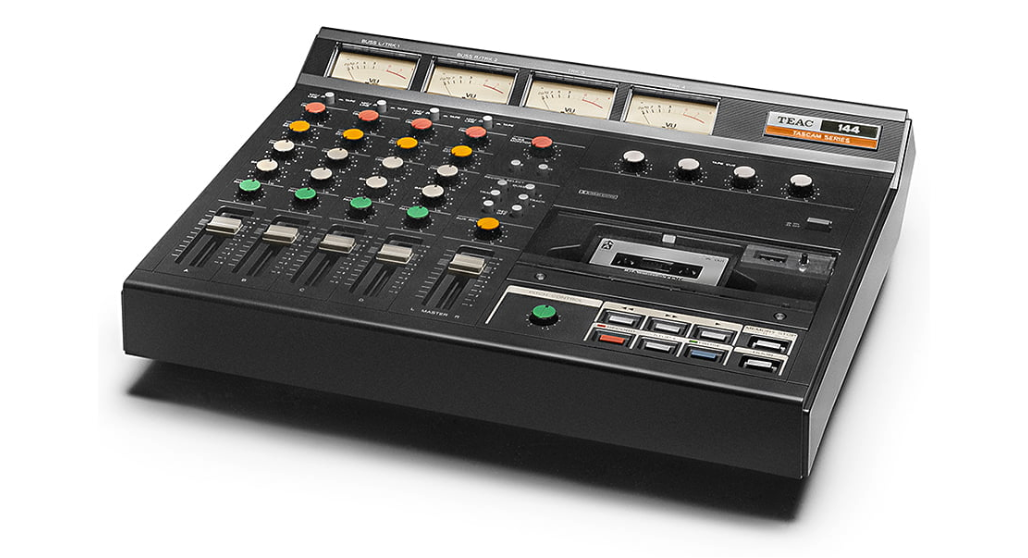
I’m addicted to YouTube, that wonderfully not-quite-random collection of entertainment, education, click bait and fake news. A little while ago, its slightly scary algorithms coughed up a video clip from the BBC’s 1980s ‘new technology’ programme Tomorrow’s World. This particular clip featured Michael Rodd exploring the original Teac/Tascam Portastudio 144 . It bought a smile to my face and a tear to my eye. If there was ever a single device that enabled the home recording studio revolution, the humble Teac 144 was it.
It was also a big part of my own fascination with recording technology; back in the day, as a teenager in a band, we booked a weekend session in a commercial recording studio. I hadn’t a clue what any of the equipment was, or how it worked, but I knew I’d found ‘my thing’. It kind of didn’t matter that it was just a local studio with some pretty basic gear (we were a pretty basic band so it was a good match!) because for teenage me, it was one of those life-changing moments.
For better or worse, that first studio experience helped define a large part of who I now am…. a recording nut with a passion for music and recording technology and a love of how that technology enables a musical idea to be created, composed and captured….
The consequence of that first studio experience was, after spending a considerable amount of time getting the required cash together, I managed to snag a second-hand Teac 144. Four tracks of audio recording onto a standard cassette tape, simple two-band treble/bass EQ on each channel, pan and a single send (if you were lucky enough to have an external reverb or delay). It was easy to use but noisy, the tapes eventually wore out and, once you started track bouncing, mixing became a bit of a nightmare. Even so, it was magical. I spent countless hours with that device and learned a lot about the basics of multitrack recording in the process.

Thankfully, my own catalogue of 144-based recordings has long since met a suitable end. However, with the right musical talent and some very good songs, you obviously could do a decent job with it; Bruce Springsteen’s was already a global sensation in 1982 on the back of albums such as Born To Run and The River. His next album was Nebraska – released in 1982 – and recorded on a Teac 144 portastudio. There are various versions of the back story but – also thanks to YouTube – an interview with the man himself where he talks through the process.
The recordings were originally intended to be song demos for the album but, once he got into the studio with his band, he soon realised that the collection of songs didn’t really benefit from a full E-Street Band arrangement. What you hear on the album – and you can stream on Spotify etc. – are his mixes from the Teac 144 to stereo cassette tape. It’s raw, unpolished, minimalist and mournful in mood, but undeniably classic Springsteen. It was also incredibly popular with world-wide sales well over a million copies.
A modern DAW would seem like science fiction to someone who has only ever experienced a cassette multitrack. Watching that Tomorrow’s World clip provides a useful reality check in terms of how far personal recording has come. MIDI and audio track counts only limited by the power of your host computer system, virtual instruments, virtual effects, comprehensive mixing with automation and total recall, pitch correction, tempo-matching, surgical editing… well, the list could go on. It’s all too easy to take for granted just how powerful our current recording systems – with a DAW at their center – have become.

I’m lucky enough to have used almost all the mainstream DAW/sequencers over the years (many as part of undertaking reviews for Sound On Sound magazine). Debates about which is the ‘best’ DAW (it depends upon the user, their needs, workflow and budget), or complaints about the lack of a specific feature in a particular DAW (any limitations are trivial compared to that Teac 144), leave me simply shrugging my shoulders. So what? Installed on a suitably specified host computer, almost any modern DAW is, frankly, capable of amazing things…. and they are all capable of performing the key recording, editing, arranging and mixing tasks that lie at the heart of every music recording project in way more powerful and flexible ways than the Teac 144 that Bruce Springsteen used for creating his classic Nebraska album.

I’m a long-standing Cubase user and I’d happily recommended it to anyone looking to build their first personal recording system. It is the heart of my own studio and I spend hours with it during a typical working week. However, when I get shipwrecked on that desert island that only happens to have Logic or Pro Tools or Studio One or Digital Performer or Reaper, I’m pretty sure I’d cope; music would be made and the occasional missing feature that might lie at the edges of its specification is not going to be what controls whether the end result is good music or bad music; that will be down to me and the quality of the songs I can write and performances I can give.
I had a blast with my Teac 144 and learnt a tremendous amount from using it, but I fully appreciate that today’s DAWs are an absolute wonderland of personal recording technology.
I love my DAW… but if I had to use your DAW, I’d know I’d soon learn to love that too.
[A version of this post first appeared in Sound On Sound magazine. You can read the original here.]